The Pre-Positioning Problem
Shaping AI Governance in the Aftermath of a Crisis

This is Part 1 of a series exploring how researchers and advocates concerned about AI risks could better influence government decision-making at the moment of an AI-related crisis.
The Hypothesis
Advocates concerned about AI risks could better influence policy outcomes at the moment of an AI-related crisis if they prepared more in advance and positioned themselves and their policies well.
This is the hypothesis the series will test. I expect my readings, interviews, and conversations along the way to sharpen or change parts of my view. What follows is my best current case for why it matters.
Some background
The development of powerful artificial intelligence systems will be one of the most consequential transitions in human history. AI has the power to radically transform human life for the better, but it comes with risks that need to be urgently addressed. Experts are seriously worried about AI-enabled disinformation campaigns, major AI-enabled cyberattacks, AI-assisted bioweapons or chemical weapons incidents, and even complete loss of control of AI systems as they become more capable than humans. Some of these capabilities are already emerging. AI systems that are more capable than humans at most cognitive tasks are expected to be developed in the next few years, and they will increasingly be used to do AI research themselves. These are not fringe concerns. They are publicly acknowledged by hundreds of leading researchers, including some of the people building the most powerful systems in the world. The timeline from “AI that seems fairly limited” to “AI that can cause large-scale harm” may be a matter of years, not decades, and the window for thoughtfully managing this transition may be short.
How Crisis Legislation Actually Works
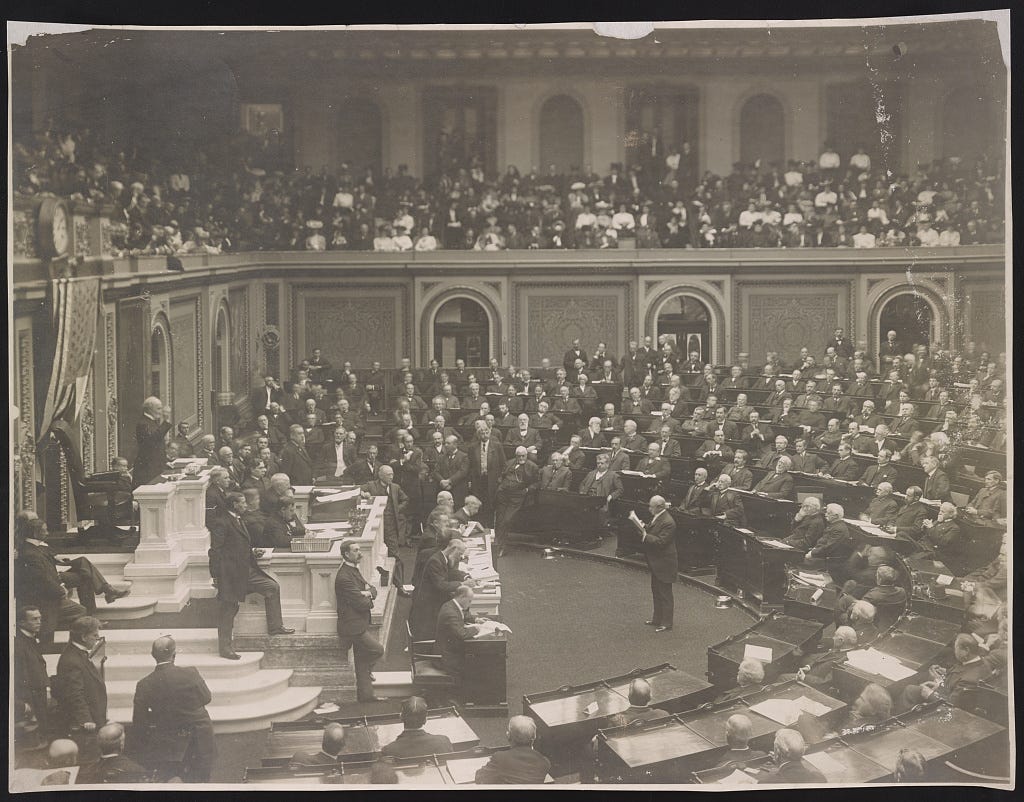
In Congress, sweeping legislation often passes quickly with unusual bipartisan support in response to a crisis. The content of that legislation is determined almost entirely by proposals that were already written, relationships that were already built, and people who were already trusted.
This pattern appears consistently across recent history. After the 2008 financial collapse, the Troubled Asset Relief Program (TARP) passed in a matter of days. Its terms were built largely around a three-page proposal that the Treasury Department had drafted months before the crisis hit. Despite its flaws, that short, pre-existing document set the terms of the negotiation.
In the aftermath of the 2020 SolarWinds hack, the Cyber Incident Reporting for Critical Infrastructure Act (CIRCIA) eventually passed in 2022, drawing heavily from the 80-plus policy recommendations that the Cyberspace Solarium Commission (CSC) had published nine months before SolarWinds became public. Over the following five years, roughly 80% of those recommendations were implemented.
After September 11, 2001, surveillance proposals that had been waiting for sufficient political will became the backbone of the PATRIOT Act within weeks of the attack.
You do not influence this process just by showing up when the crisis starts. I want to note that in all three of these examples, the legislation that ultimately passed came from internal government relationships. For advocacy organizations, pre-built relationships and pre-positioned policies are critical for shaping what governance happens in the aftermath of a crisis. I’ll dive deeper into some case studies soon.
Why AI Is Different From Most Other Risks
Most political advocacy works with risks that are relatively stable over time. Coalitions can lose legislative battles, regroup, and build again across years and election cycles, while the underlying risk stays about the same. Because the risks from AI systems could emerge so quickly, the window for government action will be compressed compared to other public safety risks.
We may go from systems that seem fairly limited to systems that can replace large portions of human digital labor, enable sophisticated cyberattacks, assist in weapons development, pursue goals that were not intended, and undermine our ability to distinguish real from fabricated, all within years, not decades. Frontier AI developers have enormous profit incentives to create a technology that replaces a large portion of human labor, which makes it hard for researchers to cooperate to reduce risks (as scientists did at Asilomar in 1975) when they are trying to compete and protect their research findings.
The handful of policy windows over the next few years when the U.S. government has the political will to address AI risks will be unusually high-leverage. Getting them right shapes how governments understand, monitor, and manage the transition to powerful AI. Getting them wrong leaves us in a worse position for every subsequent decision.
What the Field Currently Has
There is good work being done on AI safety policy. Organizations like CSET (Center for Security and Emerging Technology), FLI (Future of Life Institute), FAS (Federation of American Scientists), Gladstone AI, RAND, and others have produced congressional testimony, analytical pieces, and draft legislative frameworks. The raw material for good AI governance is being produced.
What this project is focused on is narrower than what is sometimes called crisis preparedness. I am specifically interested in the communication strategy that lets researchers and advocates concerned about AI risks affect policy outcomes when a crisis opens a policy window. Very little work exists on this specific question, even in fields outside of AI.
What “Positioning Well” Might Mean
John Kingdon’s Multiple Streams Framework (MSF), one of the most widely used models for understanding how major policy change happens, tells us that policy windows are brief and unpredictable, and that the organizations that disproportionately shape legislative responses are those that have refined their problem definitions and policy proposals in advance, and that have the relationships to get those proposals heard quickly. A March 2026 Chatham House report argues that effective policies need to be pre-positioned in advance of a crisis for governments to act decisively when a window opens. The proposals exist. The positioning is what is missing.
I will dive deeper in future posts to refine my views, but here are some ways that advocates working to reduce AI risks could improve their positioning.
It might look like investing in long-term relationships with the legislative staff who actually shape what gets drafted. Members of Congress tend to take cues from trusted close sources before outside experts, and staffers are often those close sources. Civil society groups that have invested in those staff relationships over years tend to get heard fastest when a window opens.
It might look like becoming a presence that committee chairs, agency officials, and their senior staff already know and trust as a source of expert advice, so that researchers and advocates who are aware of safety concerns are among the first calls made when policy needs to move quickly or when forming a commission.
It might look like maintaining policy proposals that are short enough to anchor a negotiation and technically credible enough to survive scrutiny, and circulating those proposals widely enough in advance that the relevant staffers and officials have already been exposed to them. The goal is for the solution to come to mind when the problem becomes urgent.
And it might look like pre-circulating clear problem definitions, so that the narrative vacuum that opens during a crisis is more likely to be filled by accurate, safety-focused framing than by industry talking points or media oversimplification.
Industry has already built much of the positioning that safety-oriented policy advocates have not. There are more than 3,500 registered federal AI lobbyists, hundreds of millions of dollars in political spending, and fast growing policy teams. Meanwhile, bridging institutions that might have connected safety-focused expertise to government have been dismantled or weakened: an executive order directing federal agencies to evaluate AI safety risks was revoked, the AI Safety Institute (AISI) was restructured with a narrower mission, and other advisory bodies (NAIAC, the CSRB) have gone dormant or been dissolved mid-investigation. There is a lot to learn from how industry has built that infrastructure, even for advocates working toward opposing legislative outcomes.
One of the central questions this series will work toward answering is how outside policy advocates actually do that pre-positioning to earn a seat at the table and affect outcomes.
What This Series Will Do
The posts that follow will go deeper on topics such as:
Case studies on how legislation happened in the wake of past crises
What comparable movements have done to position themselves for policy windows
What infrastructure currently exists for influencing AI policy, and what is missing
What a practical pre-positioning playbook for advocates might actually look like
The series will build the understanding needed to design a playbook that researchers and advocates concerned about AI risks can draw on to be more effective when the policy windows that matter most finally open.
When a crisis hits, let’s be ready to create policies that count in the limited window we might have.